Acne on your back and chest: What causes it and how to clear it
Lifestyle

Audio By Carbonatix
12:30 PM on Thursday, October 29
By Kelly Baldwin for Dove Men + Care, Stacker

A sweaty workout, a tight base layer or a backpack rubbing against your shoulders can aggravate breakouts on your back and chest. Heat, trapped moisture and repeated friction can make acne-prone skin more irritated—even when you wash regularly.
You do not need to give up exercise. Dove Men + Care explains how rubbing, changing out of damp clothing and using suitable acne treatment can help you manage breakouts without overcomplicating your routine.
Why sweat and friction matter
Clothing and sports equipment can hold heat and sweat against your skin. When they also rub repeatedly, they can trigger a type of breakout called acne mechanica.
Look for patterns. Spots beneath backpack straps, close-fitting tops or protective equipment may point to friction contributing to the problem.
Sweating is a normal part of exercise. The practical goal is to reduce how long damp fabric stays against your skin and limit unnecessary rubbing.
Adjust what touches your skin
Choose workout clothing that allows comfortable movement without chafing. Loose-fitting or moisture-wicking garments can help reduce trapped moisture.
Wash exercise clothing after each use. During activity, gently blot sweat with a clean towel rather than rubbing your chest or back.
Check equipment and straps for areas that repeatedly press against existing spots. Adjust the fit where possible without compromising protective equipment or its safety requirements.
These habits can reduce irritation, but established acne may also need treatment.
Keep post-workout care gentle
Change out of sweaty clothing and shower as soon as practical after exercise. If a shower is not available, changing into a clean, dry top is a useful first step.
Avoid trying to scrub breakouts away. Rough brushes, abrasive exfoliants and vigorous washing can aggravate acne.
Use gentle skin-care products and look for labels such as “non-comedogenic” or “won’t clog pores.” A regular body wash can cleanse skin, but it should not automatically be treated as an acne medicine.
Consider an acne treatment
For mild breakouts, a pharmacist can help you choose an over-the-counter treatment.
Benzoyl peroxide can help manage acne by targeting acne-associated bacteria. It may cause dryness or irritation and can bleach towels and clothing.
Salicylic acid helps unclog pores and can be useful for friction-related breakouts.
Follow the individual product’s directions. Introducing several treatments and exfoliants together can make irritation harder to manage and leave you unsure which product is helping.
Give your routine time
Acne treatment takes consistency. Changing products every few days makes it difficult to judge results.
Monitor whether you are developing fewer new spots and whether your skin tolerates the treatment. If friction-related acne has not improved after six to eight weeks, seek advice from a dermatologist.
Deep, painful spots or acne that leaves scars deserve professional assessment sooner.
Common questions
Does body acne mean I am not washing enough?
No. Breakouts are not a simple measure of cleanliness. Washing more aggressively can irritate your skin rather than clear it.
Should I stop working out?
Usually, you can continue exercising while adjusting your clothing, equipment and post-workout routine. Focus on reducing friction and changing out of sweaty gear.
Is exfoliating harder the answer?
No. Scrubbing can worsen irritation. An appropriate acne treatment is a better approach than repeatedly rubbing the skin.
Can I squeeze spots on my back or chest?
Avoid picking or squeezing. This can increase the risk of scarring and make inflamed spots more troublesome.
When should I see a dermatologist?
Seek help for deep or painful breakouts, scarring, or acne that is not improving with a consistent routine. If you are unsure whether the bumps are acne, a clinician can assess them before you try more treatments.
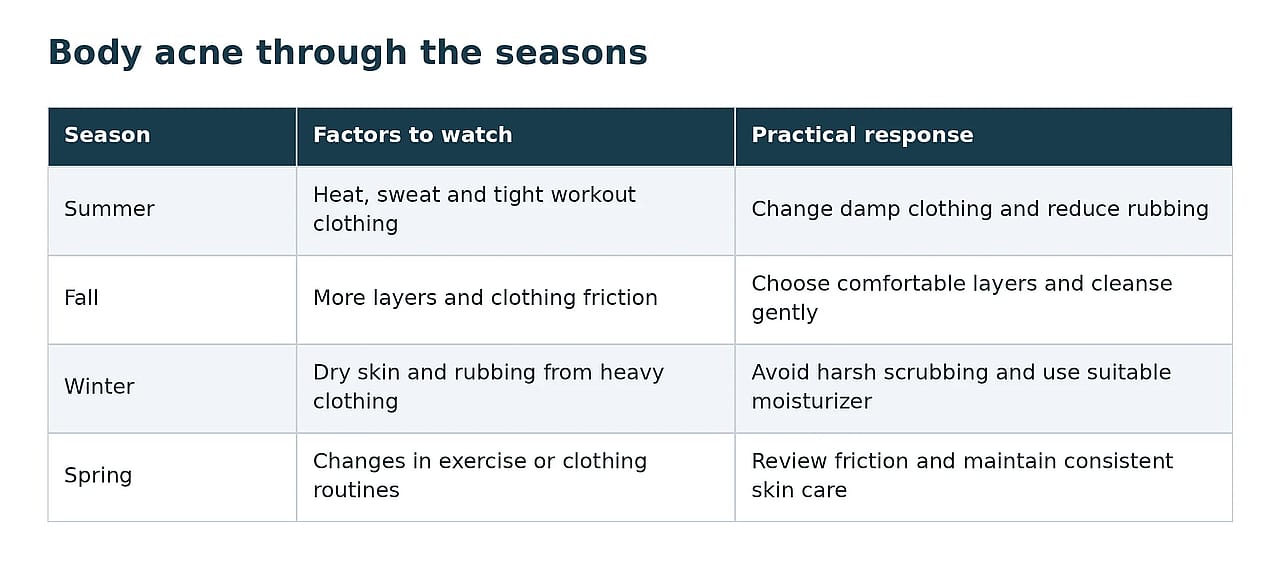
Seasonal factors to consider
This story was produced by Dove Men + Care and reviewed and distributed by Stacker.


