Aging-in-place renovations surge as homeowners invest in safety and accessibility upgrades
Lifestyle

Audio By Carbonatix
2:30 PM on Monday, March 16
By Dean Hartley for Five Star Bath Solutions, Stacker

Aging-in-place renovations surge as homeowners invest in safety and accessibility upgrades
The conversation around America’s aging population usually focuses on the macro-level: rising healthcare costs and the future of social security. But in 2026, the most visible shift is happening inside the American home. We’re seeing a massive departure from the traditional move toward retirement communities. Instead, as this article from Five Star Bath Solutions explores, older adults are doubling down on their current properties, choosing to stay independent through a trend known as “aging-in-place.”
While this choice might have seemed like an uphill battle a decade ago, modern design and better tech have made it a viable reality. The data shows that turning a family home into a safe, accessible “forever home” is now the primary driver of the domestic remodeling market.
Aging in Place Picks Up Pace
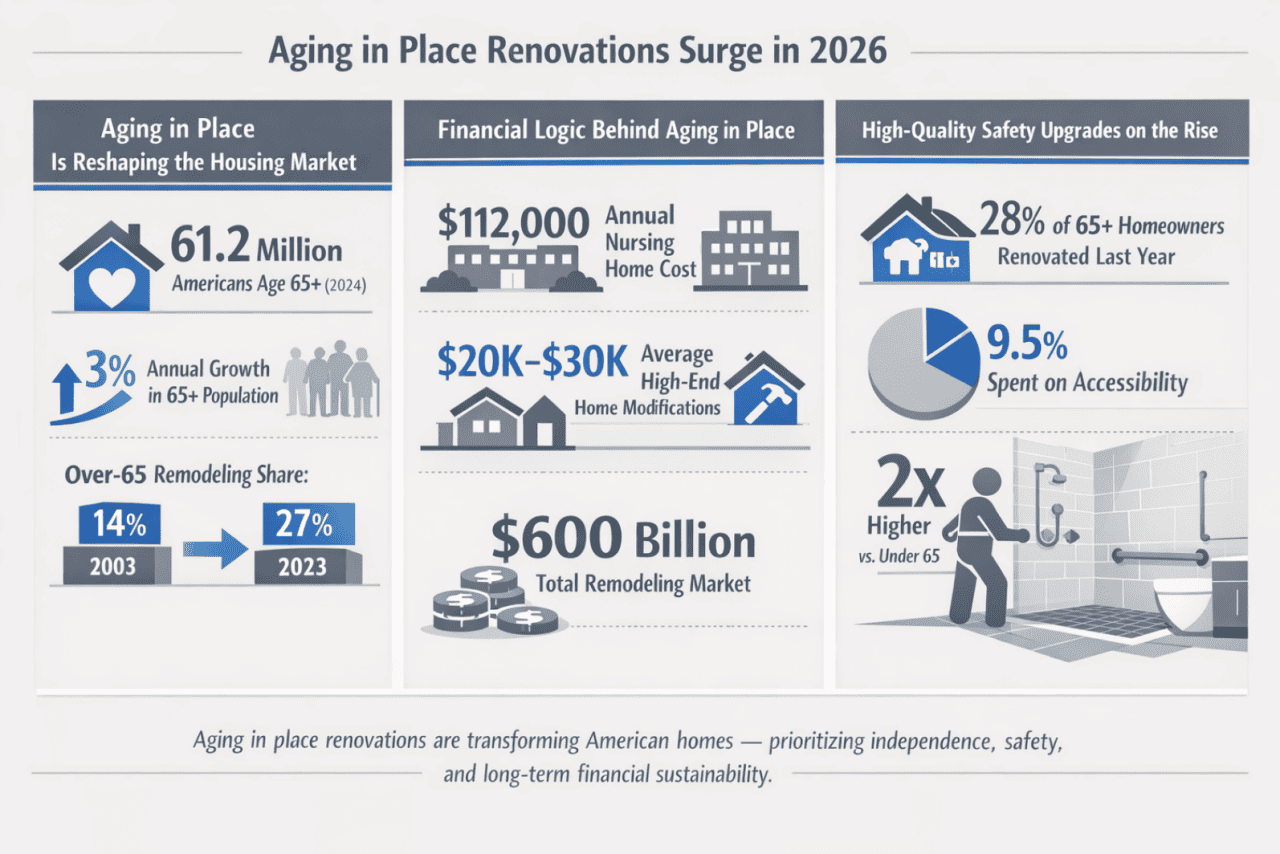
The demographic shift isn't just a talking point; it's a massive economic force. Census Bureau figures show that as of 2024, the 65-and-over population hit 61.2 million, growing by over 3% annually, while the under-18 demographic actually began to shrink.
This shift has flipped the renovation market on its head. According to the 2025 Improving America’s Housing report from the Joint Center for Housing Studies (JCHS) of Harvard University, older homeowners are now outspending their younger counterparts. Back in 2003, people over 65 accounted for just 14% of the remodeling market. By 2023, that number surged to over 27%, officially overtaking the 35-44 age bracket.
Financially, the logic is hard to argue with. With the Federal Long Term Care Insurance Program pegging annual nursing home costs at over $112,000, spending $20,000 or $30,000 on high-end home modifications isn't just a luxury—it’s an investment that pays for itself in less than a term of care.
A total of over $600 billion was spent on remodeling across all demographics last year, including major improvements, minor maintenance, and work on rental properties. Older homeowners, aged 65 and over, accounted for above-average spending. The shift is particularly apparent when compared with bygone decades.
Specifically, in 2003, the over-65s accounted for just 14% of renovation spending, while 35- to 44-year-olds accounted for 28%. By 2023, this flipped, with over-65s making up 27.2% of the total, compared with just over 20% for the 35-44 age bracket.
Today, around 28% of homeowners aged 65 and above spent money on improvements in the past year. In terms of that expenditure which went towards projects focused on accessibility and safety, the JCHS study puts this at 9.5%. That’s more than twice the proportion for under-65s.
Acting on the Data
The current wave of renovations is also seeing a shift in aesthetic expectations. Older homeowners aren't just looking for “functional” fixes; they want high-quality design that doesn't scream “hospital room.”
Industry specialists have noted a significant uptick in requests for shower conversions and curbless entryways that blend seamlessly with modern interior design. The JCHS study notes that nearly 10% of all renovation spending for seniors is now hyper-focused on these specific accessibility features. This isn't just about adding a grab bar; it's about re-engineering the most dangerous room in the house—the bathroom—to ensure long-term safety without sacrificing the home's resale value.
The JCHS data indicate that there’s a greater need and demand for renovations than there is adequate capital to fund them. A fifth of households spent nothing on improvements or maintenance in the past year, while 14% had budgets of just $500 to work with. Unsurprisingly, the lowest-income households had the lowest uptake of improvement spending, while 86% of the highest-income households pursued at least one renovation project.
Analysts advise that additional public funding for renovations aimed at enabling aging-in-place is required to close the gap between the most affluent and poorest households. Given that it is cheaper to live at home and receive care than to move to a nursing facility, so long as accessibility is improved, it’s an efficient option in the long term.
A Positive Outlook for Aging In Place
People want to live independently for as long as possible and, ideally, remain in their family home for their entire lives. To achieve this, safety and accessibility upgrades must be implemented. Moreover, these improvements must be affordable without compromising on quality, or they will fall short of the needs and the expectations of older people.
The trend for aging in place will only gather momentum, with the aging population presenting its own challenges that can be partly addressed by allowing people to adapt their homes for comfortable living into their golden years.
This story was produced by Five Star Bath Solutions and reviewed and distributed by Stacker.


