Living Stone, Holy People
Ministries > Truth For Life with Alistair Begg
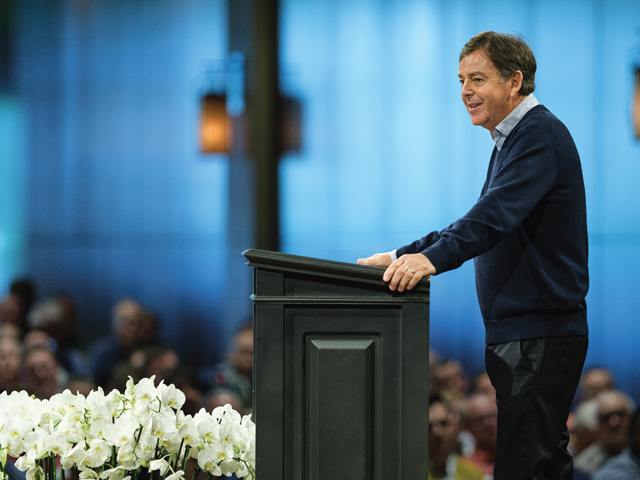
 Is your life as a Christian different from what it was before? Are you steadily growing in faith? Study along with Truth For Life as Alistair Begg shares three things that are necessary for spiritual growth—and two things that’ll impede your progress.
-----------------------------------------
• Click here and look for "FROM THE SERMON" to stream or read the full message.
• This program is part of the series ‘The Stranger’s Hope’
• Learn more about our current resource, request your copy with a donation of any amount.
Helpful Resources
- Learn about God's salvation plan
- Read our most recent articles
- Subscribe to our daily devotional
Follow Us
YouTube | Instagram | Facebook | X
This listener-funded program features the clear, relevant Bible teaching of Alistair Begg. Today’s program and nearly 3,000 messages can be streamed and shared for free at tfl.org thanks to the generous giving from monthly donors called Truthpartners. Learn more about this Gospel-sharing team or become one today. Thanks for listening to Truth For Life!
Announcer: Is your life as a Christian noticeably different from what it was before? Are you steadily growing in your faith? Today on Truth For Life, we'll learn 3 things that are necessary for spiritual growth and loving fellowship, and 2 things that will impede your progress. Alistair Begg is teaching from 1 Peter chapter 2.
Alistair Begg: The way in which we understand, at least I've tried to understand, the beginning of chapter 2 is not in light of the 24th verse of chapter 1, but in light of the 22nd verse. Because there, “Having purified your souls by obedience to the truth, for a sincere brotherly love, love one another earnestly from a pure heart.” Now, what is it going to mean to love one another earnestly from a pure heart? The Word of God has done its work in the readers to whom Peter is writing, and they are no longer what they once were. They have been ransomed, as we've been reading in chapter 1. And in many ways, they would have been akin to the folks in Crete to whom Titus is writing, and he described them as those who were passing their days in malice and envy, hated by others and hating one another. And here in the scattered regions of modern-day Turkey, the writer has to address the church in that place in the way that it is addressed in other places. The days in which they had lived according to those principles are now in the past, and now they’re living as the new people of God. He’s about to address their behavior in relationship to the outsiders. Your conduct matters when you’re outdoors. But here you will notice that he actually begins at home. At home. Sincere brotherly love, Peter says, demands action on the part of the Christian. And that action involves getting rid of stuff, putting away things, and particularly putting away the sins that spoil fellowship with one another, that mar our testimony before the watching world, and actually inhibit our ability to listen to, learn from, and benefit from the Bible itself. It's a little painful, I think, to immediately be confronted by these words: malice, deceit, actually all malice, all deceit and hypocrisy and envy, and all slander. We have to face up to this. The exhortation of the Bible in living in the family of God is very, very clear: “Be kind to one another, tender-hearted, forgiving one another, as God in Christ forgave you.” It's very, very possible to come to an event like this and have our focus just magnified around the world, turn our gaze to here and there and learn and benefit, and then go back into our own church families and fall foul of the very things that Peter is addressing here. Our church families are supposed to be places of kindness, genuine kindness. There’s supposed to be not a steely, refrigerated dimension to the way in which we engage with one another, but a tender-heartedness that is not sentimentalism, that there is a forgiveness with the wrongs that we perpetrate and experience, a forgiveness that is exercised because we are keenly aware of the forgiveness that has been extended to us. That's supposed to be the experience when people walk into our churches, because these elements are increasingly being eradicated. And the tone that is sounded in a church—and this is hard to face up to, but it is important to acknowledge—the tone so often is the tone that comes from the pulpit. From the pulpit. So that the pastor or the shepherd of the flock or the leaders of the flock set the tone. And when that tone goes wrong, then it is very, very obvious. So progress in living as the people of God comes for us often slowly, and we do need one another, and we need these exhortations. But it involves not only putting away, but also, as he immediately goes on to say, putting in. Putting in. And I was reading Luther last night, and at one point, he says to those to whom he's writing, “Make sure that your points are short and clear.” And so I looked at my notes, and I thought, well, they're not short, and they're not particularly clear. And so here are my three points for this morning. Fed up, build up, show up. All right? Fed up, not as in, are you fed up with these talks, but—which is another subject altogether—but are you fed up? Are you feeding on the Scriptures? Are you feeding on the Word of God? Are you, like a newborn baby, excellently exposed to the longing of having that which is beneficial to your progress? It is evidence of health. Indeed, when there is an absence of the ability to feed, when there is an absence of desire, it is more often than not, the pediatricians tell us at least, that it is an indication of an underlying issue or an underlying problem. We wouldn’t want to overdramatize it, but sometimes when the child is there, they seem largely disinterested in feeding, and someone will say, “Oh, I think she’s just sleepy.” Or someone will say, “Well, I think perhaps she’s lazy,” or perhaps something worse. An absence of a desire for the Word of God is unhealthy and unnatural in the life of a Christian that is making progress. When James similarly addresses these things, he tells us in his first chapter there that there are two things that will dramatically inhibit the benefit of being the recipients of the truth of the Word of God, will somehow or another make it very, very difficult for us to grow up into the salvation that is provided for us as the Word of God comes to bear upon us. And the two things are these, you can find them. Number one, an angry heart, and number two, a dirty mind. Put away anger, it cannot produce the righteousness of God. And put away all filthiness, so that you may receive the implanted word which is able to save your souls. We can simply pass over that, but we can't avoid it. The eagerness, says Peter, of a newborn is to be matched by the Christian in the Christian life when it comes to feeding time. Feeding time. Personal devotional life matters. The gathering of the people of God. Assemble the people. Assemble the people before me to hear my words. Deuteronomy 4:10. The vital importance of gathering to hear from God, to have a divine encounter with God through the Word of God by the Spirit of God, so that the Word of God becomes the driving force that shapes the people of God and frames church life. By pure spiritual milk, he says, because you’ve tasted the goodness of the Lord, therefore you will want to know him more and more. By this pure spiritual milk, you may grow up into salvation. It's an interesting phrase, isn't it? Growing up into something. This makes me think of a school uniform, actually. Your mother, if she was a Scottish mother, I mean, your jacket looked like you had lost your arms when you went up first. But she said, no, it's good that you would have this because you can grow into it. You can grow into it. Or when your aunt says, what is that? Your mother says, He'll eventually fill it out. And so it is that the journey of the Christian life is fantastic, because salvation is so vast. We think when we come to taste the goodness of the Lord, we've got it. Well, we've got him, but there is so much more of him to know. There are depths of grace that we have yet to discover. And so he's saying to them, Listen, this Word of God that has been proclaimed to the world is such that it needs to be the lamp to your feet, the light to your path, the map for your journey, the food for your souls. And so we need to be fed up. Fed up. Not only fed up, and I use that, I hope it's just to register in our minds, and if not, again, I told you, just come up with your own outline. But it's not only that we are to be fed up, but it is in order that we might be built up. Built up, as you come to him, a living stone. And Peter, of course, was so radically transformed by the resurrection, as were his colleagues, that that was immediately on his lips. It was very easy for him to refer to Jesus in this way as the living one. On Pentecost, he stands before the crowd that listens to him, and he's proclaiming the fact that Jesus is alive. God raised him up, raised him up, loosing the pangs of death, because it wasn't possible for him to be held by it. This Jesus, he said, God raised up, and of that we are witnesses. As you come to him. We don't come to a philosophy. We don't come to an ideology. We don't come to a program. We come to a person. Nicodemus came to Jesus by night. As a result of the woman that had been transformed by an encounter with Jesus at the well, the people then were coming to Jesus. When we come to Jesus, the living stone, who is rejected by men but chosen and precious in the sight of God, this is my beloved Son, you yourselves, like living stones, are being built into a spiritual house. So, in other words, in our coming to Jesus and by virtue of our union with Christ, who is the living cornerstone, then we are metaphorically living stones being built into a spiritual house. Now, that terminology was understandable then, and it is now. In the Old Testament, the temple was the dwelling place of God. Peter is pointing out that now God’s chosen sanctuary is his people. And Peter here moves very quickly between his pictures, doesn’t he? You’ve got babies on the one hand, and then you’ve got temples and stones, and now you’ve got a priesthood. A priesthood. This doesn’t—the priesthood of all believers—does not somehow or another set aside the role of the pastor in Ephesians 4, but we are given the privilege of bringing the sacrifice of praise into the house of God. I enjoyed very much the communion service as it was led last night, and I listened very carefully to the way in which it was framed, and the understanding that, as in the Old Testament, there were propitiatory sacrifices, and then there were dedicatory sacrifices that were offered in response to the sacrifice of propitiation. And that, of course, is the picture of Paul in Romans 12, where he says, “I beseech you by the mercies of God,” embodied in, if you like, in the atoning sacrifice of Jesus. I beseech you, on the basis of his atoning sacrifice, to offer your lives wholly acceptable to him as a sacrifice of praise. And so Peter quotes the Scripture, and he quotes it in such a way that he's in no doubt at all. I'm looking now at verses, what, 5 and 6 or so. He's in no doubt at all, unlike some of our friends, that Jesus alone is the cornerstone. If there ever was going to be a time when he was going to apply this to himself, this would be perfect. After all, it's his letter. He said, you know, some of you will have read Matthew chapter 16, and you know this and so on. Well, he's got it very clear in his mind. Jesus is the cornerstone, Jesus rejected by the builders, the builders that we might have thought would be most ready to welcome him. Jesus is the one, as Simeon put it, who is appointed for the rising and falling of many in Israel. Jesus is the rock of salvation, upon whom we take our stand or over whom we stumble. There is no refuge from him, save the refuge that is in him. You are being built up, he says. This is what God is doing with you. He's fashioning you according to his plan and purpose. And in the variegated nature of all these stones, he is fulfilling his plan. Now, of course, these people who are reading this letter will inevitably have felt themselves to be somewhat marginalized, as we go on and read in the letter that they were suffering. As a result, they may feel small and insignificant. And what an encouragement for them to read this truth, that although they may not look like much, they are part of God’s building. Part of God’s building. We need to be fed up because we’re being built up, and it’s time for us to show up. You say, well, you're really stretching it now, Begg. Well, I think I can justify this one. All right. Peter then takes these descriptions of Old Testament Israel, and he applies them to the church. You are, he says, a chosen race, a royal priesthood, a holy nation, a people for his own possession, that you may proclaim the excellencies of him who called you out of darkness and into his marvelous light. He has fed you, he is building you in order that you might show up and show him up, as it were. And the pictures that are there would be understood especially by the Jewish readers. Isaiah 43, the people whom I formed for myself, that they might declare my praise. In Exodus, you shall be my treasured possession among all peoples, for all the earth is mine, and you shall be a kingdom of priests and a holy nation. Now, what he's saying there is that the choice of God is not because we are favorites. The choice of God is because we are witnesses, in order that we might show up and proclaim the glory, the excellency, the power, the authority, the saving goodness of the Lord Jesus, who has called us out of darkness and into his marvelous light. Loved ones, this is what we have to make sure we are not only believing, but we are actually proclaiming: that both in our hymnody and in our Bible studies, and certainly from our pulpits, we are showing forth the grace of God. We are reading the Word of God, we are being built up into the people of God, and we are showing up in order that the world might understand this. It is something of a problem, isn't it? which is an understatement, when instead of this kind of proclamation, instead of the gospel of grace ringing out from our pulpits, we discover the pulpits have actually begun to proclaim the wisdom of Christopher Robin in Winnie the Pooh. You say, well, really? Yeah, really. Christopher Robin says to Winnie the Pooh at one point, “Pooh, you need to know you are braver than you believe, you are stronger than you seem, and you are smarter than you think.” Oh, that would reach for a spoonful of honey, I think, to go along with that, for sure. What a cozy word. What a cozy word. And you don't just get this from Oprah. You don't just get this from Joel and Your Best Life Now. No, if you listen carefully and painfully, you will discover that the philosophy of A. A. Milne is sneaking in and squeezing out of the lips of men who should know better, who for some reason have decided that contextualization means making sure that everybody knows how good, fine, kind they are, and making sure they all go away just a lot happier than they were when they came. What a difference from this amazing word. You are not that brave, Begg. We have an alarm in our place. I hope it never rings in the house. I heard a noise some time ago. I said to my wife, “You know, there’s a noise, is it?” And she said, “Yeah.” I said, “Well, aren’t you going to do something?” I wish I was making this up. I'm not. And I won't go on with the story, but there was a noise, and there was a policeman in the house because the alarm had gone off or something. I don't know what it was, but she was there, and I wasn't. You're stronger than you seem. Most men are around in the kitchen in order to take the tops off jars. My wife is around in order to take the top off the jar. I'm not as strong. I'm not that strong. And clearly, you've already deduced I'm not that smart. Consider your calling, brethren. Why don't all the really bright ones stand up right now? How about all the people from an honorable background? You stand up. And how about the rest of us recognize this: that in the economy of God, if dependence is the objective, which it is, then weakness is the advantage. And all these titles fitted perfectly because the Son of God loved them, gave himself for them, and was dispatching them to the world. Dispatching them to the world. And we all understand it when we dig out our old movies and we turn to Chariots of Fire, and we recognize how amazing it is that a hundred years after the 1924 Olympics, in the secular press, at least in the States, there were numerous statements concerning Eric Liddell, and that was because of his faith. That was because of the fact that he knew, when he was chided by his sister at Edinburgh University about showing up late for the Bible class. He wasn't trying to miss the Bible class, but he was physically training. And she told him, you know, God made you, made you for himself. And he says, Aye, Jenny, I know. He made me for himself. He made me for China, but he also made me fast, and when I run, I feel his pleasure. When he left from the railway station in Edinburgh to go to China, back to China where he'd been born, he got on the train, rolled down the window, and he shouted out to the gathered crowd, which wasn't a Christian crowd, it included Christians. He gathered them out around, and he shouted out, Christ for the world, for the world needs Christ. And then he led them in the singing of Jesus shall reign where'er the sun doth his successive journeys run, his kingdom stretch from shore to shore, till moon shall wax and wane no more. Fed up, build up, show up.
Announcer: You're listening to a message titled Living Stone, Holy People on Truth For Life with Alistair Begg. As we look ahead to a new year of teaching the Bible through Truth For Life, we are grateful for all God has made possible in 2026. We're looking forward to all he will do next year, and we know that when his word is faithfully proclaimed, his spirit will use it to transform the lives of those who listen. That's why we want to ask you to kindly remember Truth For Life as you make year-end giving plans. As you prepare your 2026 charitable donations, keep in mind that our ministry is 100% listener funded. We rely entirely on your support, and year-end is a particularly important time for us as we aim to meet our financial obligations and successfully close out another year of ministry so we can be ready for 2027. We're grateful for your partnership in this global gospel outreach. You can give securely online at truthforlife.org/donate, or feel free to call us at 888-588-7884 to arrange your year-end donation. Thanks for listening today. Hope you have a great weekend and are able to worship with your local church. On Monday, we'll learn how our conduct testifies to our new life in Christ. The Bible teaching of Alistair Begg is furnished by Truth For Life, where the learning is for living.
Related Episodes
Elizabeth and Zechariah (Part 1 of 2)
Saturday, November 14
New Life, New Lifestyle (Part 2 of 2)
Thursday, November 12
New Life, New Lifestyle (Part 1 of 2)
Wednesday, November 11
About Truth For Life
Truth For Life distributes the unique, expositional Bible teaching of Alistair Begg. Studying God’s Word each day, verse by verse, is the hallmark of this ministry. In a desire to share the good news of the Gospel without cost as a barrier, the entire teaching archive is available for free download and resources are available at cost with no markup.
About Alistair Begg
Alistair Begg has been in pastoral ministry since 1975. Following graduation from The London School of Theology, he served eight years in Scotland at both Charlotte Chapel in Edinburgh and Hamilton Baptist Church. In 1983, he became the senior pastor at Parkside Church near Cleveland, Ohio. He has written several books and is heard daily and weekly on the radio program, Truth For Life. The teaching on Truth For Life stems from the week by week Bible teaching at Parkside Church. He and his wife, Susan, were married in 1975 and they have three grown children.Contact Truth For Life with Alistair Begg
Website
http://www.truthforlife.org/?utm_source=oneplace&utm_medium=sitelinks&utm_campaign=home
Mailing Address
Truth For Life
P.O. Box 398000
Cleveland OH 44139
Telephone (Customer Service)
888-588-7884 Domestic
400-543-6800 International
440-543-0522 ( Fax)


