The Spiritual Forces of Evil (Part 1 of 4)
Ministries > Truth For Life with Alistair Begg
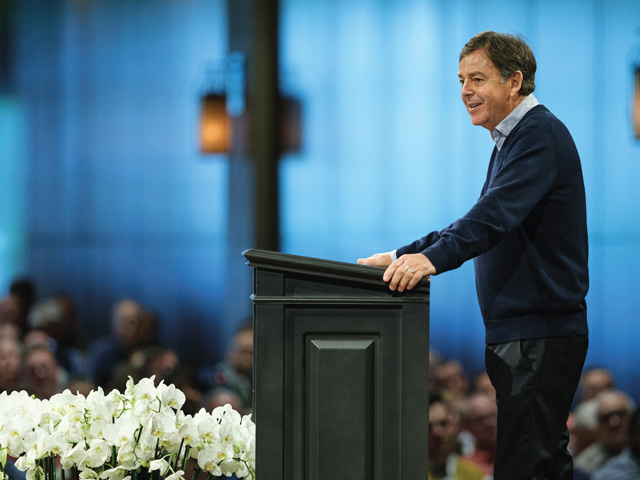
 What’s wrong with our world? Why does it seem like hostility so often prevails and relationships of every kind are so easily broken? Join us on Truth For Life as Alistair Begg looks to the Bible to find the root that ultimately underlies all conflict.
-----------------------------------------
• Click here and look for "FROM THE SERMON" to stream or read the full message.
• This program is part of the series A Study in Daniel, Volume 2’
• Learn more about our current resource, request your copy with a donation of any amount.
• FREE AUDIOBOOK! In our polarized culture, disagreement is often seen as combative and offensive. What if there were a way to do it well? Download your free copy of The Art of Disagreeing by Gavin Ortlund and master how to disagree with kindness and influence. Request yours at ‘truthforlife.org/disagree.’
Helpful Resources
- Learn about God's salvation plan
- Read our most recent articles
- Subscribe to our daily devotional
Follow Us
YouTube | Instagram | Facebook | X
This listener-funded program features the clear, relevant Bible teaching of Alistair Begg. Today’s program and nearly 3,000 messages can be streamed and shared for free at tfl.org thanks to the generous giving from monthly donors called Truthpartners. Learn more about this Gospel-sharing team or become one today. Thanks for listening to Truth For Life!
Guest (Male): What's wrong with our world? Why does it seem like hostility so often prevails? Relationships are easily broken personally, politically, culturally, and internationally. Today on Truth for Life, Alistair Begg looks to the Bible to find the root cause that ultimately underlies all conflict.
Alistair Begg: Daniel chapter 10. In the third year of Cyrus, king of Persia, a word was revealed to Daniel, who was named Belteshazzar. And the word was true, and it was a great conflict. And he understood the word and had understanding of the vision. In those days, I, Daniel, was mourning for three weeks. I ate no delicacies, no meat or wine entered my mouth, nor did I anoint myself at all for the full three weeks. On the 24th day of the first month, as I was standing on the bank of the great river, that is the Tigris, I lifted up my eyes and looked, and behold, a man clothed in linen, with a belt of fine gold from Uphaz around his waist. His body was like beryl, his face like the appearance of lightning, his eyes like flaming torches, his arms and legs like the gleam of burnished bronze, and the sound of his words like the sound of a multitude. And I, Daniel, alone saw the vision, for the men who were with me did not see the vision, but a great trembling fell on them, and they fled to hide themselves. So I was left alone and saw this great vision, and no strength was left in me. My radiant appearance was fearfully changed, and I retained no strength. Then I heard the sound of his words, and as I heard the sound of his words, I fell on my face in deep sleep with my face to the ground. And behold, a hand touched me and set me trembling on my hands and knees. And he said to me, "Oh, Daniel, man greatly loved, understand the words that I speak to you, and stand upright, for now I have been sent to you." And when he had spoken this word to me, I stood up trembling. Then he said to me, "Fear not, Daniel, for from the first day that you set your heart to understand and humbled yourself before your God, your words have been heard, and I have come because of your words. The prince of the kingdom of Persia withstood me 21 days, but Michael, one of the chief princes, came to help me, for I was left there with the kings of Persia, and came to make you understand what is to happen to your people in the latter days. For the vision is for days yet to come." When he had spoken to me according to these words, I turned my face toward the ground and was mute. And behold, one in the likeness of the children of man touched my lips. Then I opened my mouth and spoke. I said to him who stood before me, "Oh, my lord, by reason of the vision, pains have come upon me, and I retain no strength. How can my lord's servant talk with my lord? For now no strength remains in me, and no breath is left in me." Again, one having the appearance of a man touched me and strengthened me. And he said, "Oh, man greatly loved, fear not, peace be with you. Be strong and of good courage." And as he spoke to me, I was strengthened and said, "Let my lord speak, for you have strengthened me." Then he said, "Do you know why I have come to you? But now I will return to fight against the prince of Persia. And when I go out, behold, the prince of Greece will come. But I will tell you what is inscribed in the book of truth. There is none who contends by my side against these except Michael, your prince. And as for me, in the first year of Darius the Mede, I stood up to confirm and strengthen him." Amen. What is actually wrong with our world this morning? What is wrong with our world? How come it is so unbelievably broken? You may have been asking yourself the question. You may actually have come along to church this morning in the hope that perhaps somewhere along the line you may find an answer to that question because you're deeply concerned, and understandably so. What is wrong with the world? How do we account for the atrocities of these days? Why is it that in all of our attempts at unity, unity of the nations and of the homes and so on, there is so much conflict in our world? And perhaps most importantly of all, when, if ever, will it all end? This is not just a piece of rhetoric. I'm finding, and I'm sure you're finding too, that these questions abound at the moment, and it makes perfect sense. And it may be of surprise to us, and then perhaps we can pass it on to others, to acknowledge the fact that the 10th chapter of Daniel actually helps us in this matter. That it doesn't help us in a way that is exclusive to the 10th chapter; it is in keeping with the rest of the book and it enables us to grapple with these kinds of questions. Chapter 10 is the beginning of the closing section of the book. It is largely a vision that is followed by a prolonged prophecy that runs all the way through chapter 11 and into chapter 12. And as we've said so many times in this study, it is absolutely imperative that we don't allow ourselves to be distracted by the debatable details, but instead make sure that we are majoring on the major themes that unfold for us from the text. We have said again and again, quoting the Westminster Confession, that not all parts of the Bible are equally understandable or as easy to understand as other parts. But those parts that relate to the unfolding story of salvation, both in their statements individually and in the impact of them cumulatively, leave a man or a woman in no doubt that salvation belongs to the Lord. Now, it is immediately clear from the reading of the opening verse that Daniel has been made aware of what he refers to as a great conflict. And this word that has come to him has been understood, and he has something of an understanding of the vision. To that vision, we will come later in the day, all being well. And what he is making clear to us in recording it for us is that what was happening on the ground was tied to conflict in the heavenly realms. That the unfolding drama of history needs to be understood in light of all that the Bible makes clear concerning history. Again to repeat ourselves, we have said on numerous occasions that the only way that we can really understand world history is with our Bibles. Not that all the events in the unfolding story of history—I haven't found the Battle of Hastings in the Bible; I haven't found Napoleon in the Bible and so on—but nevertheless, it is the way in which the Bible unfolds the drama of history that we can then say, well, I can begin to make sense of what is going on here. Wouldn't you agree that the events of the last 10 days or so have created the impression in many of us that there is something far deeper, something far more sinister behind these horrific events in our world? And particularly those events which are making clear the fierce opposition of many in our world to the person and work of the Lord Jesus Christ, and consequently, to those who name the name of the Lord Jesus Christ. And one of the questions must surely be: Why is it that that is the case? Why should it be? Why should it be that the followers of Jesus are so manifestly opposed, unlike the followers of other religious figures? Abraham Kuyper is famous for a lot of things, but his one great quote that most people know reads as follows: "There is not one square inch in the whole domain of our human existence over which Christ, who is Sovereign over all, does not cry, 'Mine!'" Not one square inch in the entire domain of human existence exists apart from Christ. The person you are sitting next to could not exist, does not exist apart from Christ. The water that comes out of your tap does not exist apart from Christ. The stars in the sky, and so we can go through bearing testimony to what Kuyper is saying. Jesus, says Paul when he writes to the Ephesians, has been raised from the dead. He is seated in the heavenly places, far above all rule and authority and power, and above every name that is named, not only in this age but also in the one to come. Now Paul is writing that to the church in Ephesus who are opposed, who find that they are marginalized, who are suffering from all kinds of trials directly related to their affirming of the fact that Jesus is the Savior of all who will come to Him in faith. And it is on account of that that the evil one and his minions are opposed to that very reality and consequently engage in conflict. Now, this is not something that springs up from nowhere. This is the conflict that is announced for us at the very beginning of the Bible in Genesis chapter 3 and to which we refer from time to time. It’s referred to in theological terms as the proto-evangelion or euangelion. And here it is: God speaks to the serpent, to Satan, and He says, "I will put enmity between you and the woman and between your offspring and her offspring. He shall bruise your head, and you shall bruise His heel." Here you have this prophecy eventually pointing forward to Christ who is to come. And as a result of that, all conflict in the world ultimately may be traced to that one root. Now, you're not going to get this from listening to the news. I don't think I've heard anybody or read in any newspaper this week anybody say, "Well, you know, there's no surprise that all this is going on because after all, we exist with conflict in the heavenly realms." There is a great cosmic battle that ensues in a realm that we do not actually see and which we are prone to reject as scientific rationalists, as people who say all that we have is now and all the reality is in the tangible and the seeable and in the observable and so on. And the Bible challenges that. Our fight then, says Paul in Ephesians 6, having identified the triumph of Christ, is not against a physical enemy. It is against organizations and powers that are spiritual. We are up against the unseen power that controls this dark world and spiritual agents from the very headquarters of evil. Now you're going to have to decide whether you believe this or not. You're going to have to determine whether you're going to bow down under the authority of God's word and realize that the conflict in our world and the opposition to the Lord Jesus and to His people, which is manifest in many parts of our world today, is not simply as a result of political bumbling, ineptitude, a bad attitude on the part of people. But it’s traceable to the fact that within the corridors of power, within the governments of the world, there are dark and sinister unseen forces that are at work, that the very people who are making decisions unwittingly may be the very agents of these things. That sounds so bizarre, doesn't it? Let me quote Kuyper again in his second most famous quote, in the opening, I think, of the Free University of Amsterdam. This is what he says: "If once the curtain were pulled back and the spiritual world behind it came to view, it would expose to our spiritual vision a struggle so intense, so convulsive, sweeping everything within its range, that the fiercest battle ever fought on earth would seem by comparison a mere game. It is not here, but it is up there. That is where the real conflict is waged, and our earthly struggle drones in its backlash." The most powerful forces in our world are unseen forces, and we actually live our lives largely, if not in some cases completely, unaware of the spiritual battles that ensue in the heavenly realms. And if we had ever doubted that, surely our studies in Daniel make it perfectly clear to us that God is revealing to His servant six centuries B.C. that the immediacy of the conflict on the ground that the people of God are facing there is emblematic of that which will continue through the ages until, in this final great denouement, when Christ who is all in all comes, He will usher us into an entirely different realm. Now, that seems like a very long introduction and I guess it is. But it is purposeful. I want to try and make sure that we set the scene. I then want us to get no further than really just the first two or three verses. We'll come back to the bulk of it later on. I wrote down in my notes just a heading that reads: "Daniel Still Serving After All These Years." And those of you who are Paul Simon fans will recognize just where that notion comes from. Instead of "still crazy after all these years," which fits many of us, Daniel is still serving after all these years. Now, it is interesting to me, and I hope to you as well, thereby making it worthy of comment, that this first verse of chapter 10 seems to be directly taking us back to the beginning of the entire book, identifying the time frame as being in the third year of Cyrus, the King of Persia, a word revealed to Daniel who was named Belteshazzar. Well, we know he was named Belteshazzar. Why mention it here? Well, presumably to remind us that what is happening in chapter 10 is directly tied to all that has preceded. If you go back to Daniel chapter 1 for just a moment, you see there that it is in verse 7 that the chief of the eunuchs gave them their names, and Daniel he called Belteshazzar. And in verse 21, the very final verse of the chapter, "And Daniel was there until the first year of King Cyrus." Well, now chapter 10, verse 1: "In the third year of Cyrus, King of Persia." I think it's a deliberate reinforcement of these things so that we might recognize that God, who had put him in that position, was still with him, and this Daniel was still serving. You say, well, he was supposed to be there until the first year of the King of Cyrus, and now it says that in the third year of King Cyrus, he was still there. Oh, yeah. It just said that he'd be there until the first; it didn't say he wouldn't be there for longer than the first. Maybe it was until the first that that rounded out his formal service, and after that, he's in a kind of retirement mode. And so by the time we get to year three, he is confronted by this word, he understands something of the vision, and then having given to us this kind of editorial introduction, he's then going to tell us exactly what was going on. Now, as I studied this, I thought it would be purposeful to pause for a moment and just recognize three aspects of Daniel's life and service. He is distinguished by his service of the living God. You remember back in chapter 6 when he's in the den of lions and the king, who's had a very broken night of sleep, comes down early in the morning to see if Daniel is still around. And when he cries out in an anguished voice, you remember what it says he cried out. He came near to the den, this is the 20th verse of Daniel 6, he came near to the den where Daniel was, he cried out in a tone of anguish, declaring, "Oh Daniel, servant of the living God." He didn't say, "Oh Daniel, dreamer of dreams, visionary, Daniel, great leader, Daniel, fantastic administrator." All of those things were true. No, he says, "Daniel, servant of the living God." And then he asks, "Has your God, whom you serve continually, been able to deliver you from the lions?" And of course, the answer was yes. And so it is that we have him identified throughout the entire book in relationship to his service of the living God. Well, here are the three words that I want you to get. Number one: To notice that he is faithful. That he is faithful in this respect. By this time, he was an old man. If he'd been taken away at the age of 18 and these years have elapsed that are 70, then he's 88. He's definitely in the second half of his eighth decade. He's the age of some of us here. He's the age that some of us hope we will one day become. And throughout the book, he has been marked by his faithfulness in two respects particularly: absolutely faithful in listening to the word of God and absolutely faithful in seeking the face of God. Listening to His word and seeking His face. That was the thing that annoyed his friends and his companions. "Why do you have to be this way? Why can't you just be like everybody else? Why do you have to be so engaged with all of this stuff?" And that, of course, was the basis of their charge against him because they knew that they could find him in that situation because of his faithfulness in these regards. He is, if you like, the embodiment of the second half of Isaiah 66:2: "This is the one to whom I will look," says the Lord, "he who is humble and contrite in spirit and who trembles at my word." And it is in this trembling response to the word of God that we find Daniel here. Now again, it is important to realize that the third year of Cyrus, the King of Persia, is a marker for us to recognize what is going on elsewhere. And here you need to turn to Ezra and to chapter 1 for just a moment in order that you can get a hold of this. Ezra chapter 1 reads: "In the first year of Cyrus, King of Persia, that the word of the Lord by the mouth of Jeremiah might be fulfilled, the Lord stirred up the spirit of Cyrus, King of Persia, so that he made a proclamation throughout all of his kingdom and also put it in writing." And so a number of them leave. But interestingly, Daniel doesn't leave. Well, I suppose part of the reason that he wasn't going back is that he didn't want to go back. When you're 86, you presumably don't want to do some of the things that you did when you were 46 or 36 or 26 or even 76. He wasn't as physically commanding as he would have been as a younger man, and after all, there were people like Ezra and Nehemiah and their helpers who were put in position ostensibly in order that they might do the heavy lifting. So Daniel stays. And he does some heavy lifting of his own. What is that heavy lifting? He prays. His faithfulness is revealed in listening to the word of God and seeking the face of God, and as he seeks the face of God, having understood the great conflict that is about to come, he prays for the people of God immediately in their return to Jerusalem and in the awareness of the conflict that will ensue following that return. In other words, quite remarkably, he is committed to a project in which he himself had no immediate part and the conclusion of which he would not live to see.
Guest (Male): You’re listening to Truth for Life with Alistair Begg. We’ll hear more about the vital work of the faithful tomorrow. As we learned in today’s message, Jesus is the Savior of all who come to Him in faith and He is sovereign over all, above every name that is named. It is these truths about Jesus that ignite the fury of the evil one but give confident hope to believers. To understand all of this better, we have a special offer for you today from Truth for Life. It’s an ebook titled *Name Above All Names*, and you can download it for free. The book was co-written by Alistair and his friend and fellow theologian, Sinclair Ferguson. They take a close look at the unique nature of the Lord Jesus and the various ways the Bible describes His character and ministry. For example, in the book, you’ll learn why Jesus is given names like the Son of Man or the Suffering Servant, the Lamb on the Throne. Why these identities are an encouragement to all believers. *Name Above All Names* delivers an in-depth exploration of seven qualities of Jesus’ identity, offering remarkable insights from two seasoned pastors to give you a well-fortified appreciation for the person and work of Jesus. The ebook comes with a companion study guide that provides questions to help you dig deeper into the teaching. It contains seven sessions, one for each chapter in the book. It’s perfect for personal reflection, or you can use it with your small group Bible study. And you can download the *Name Above All Names* ebook and the study guide for free today at truthforlife.org/name. Thanks for listening today. As we get older, we may not be able to do all the things we did in our youth. We may retire from our jobs when we reach a certain age, but we still have work to do for God. Tomorrow, we’ll find out why. The Bible teaching of Alistair Begg is furnished by Truth for Life, where the learning is for living.
Related Episodes
The Spiritual Forces of Evil (Part 2 of 4)
Wednesday, August 5
Gabriel and the Seventy Weeks (Part 2 of 2)
Monday, August 3
“Do You Believe…?” (Part 2 of 3)
Saturday, August 1
About Truth For Life
Truth For Life distributes the unique, expositional Bible teaching of Alistair Begg. Studying God’s Word each day, verse by verse, is the hallmark of this ministry. In a desire to share the good news of the Gospel without cost as a barrier, the entire teaching archive is available for free download and resources are available at cost with no markup.
About Alistair Begg
Alistair Begg has been in pastoral ministry since 1975. Following graduation from The London School of Theology, he served eight years in Scotland at both Charlotte Chapel in Edinburgh and Hamilton Baptist Church. In 1983, he became the senior pastor at Parkside Church near Cleveland, Ohio. He has written several books and is heard daily and weekly on the radio program, Truth For Life. The teaching on Truth For Life stems from the week by week Bible teaching at Parkside Church. He and his wife, Susan, were married in 1975 and they have three grown children.Contact Truth For Life with Alistair Begg
Website
http://www.truthforlife.org/?utm_source=oneplace&utm_medium=sitelinks&utm_campaign=home
Mailing Address
Truth For Life
P.O. Box 398000
Cleveland OH 44139
Telephone (Customer Service)
888-588-7884 Domestic
400-543-6800 International
440-543-0522 ( Fax)


