The Spiritual Forces of Evil (Part 2 of 4)
Ministries > Truth For Life with Alistair Begg
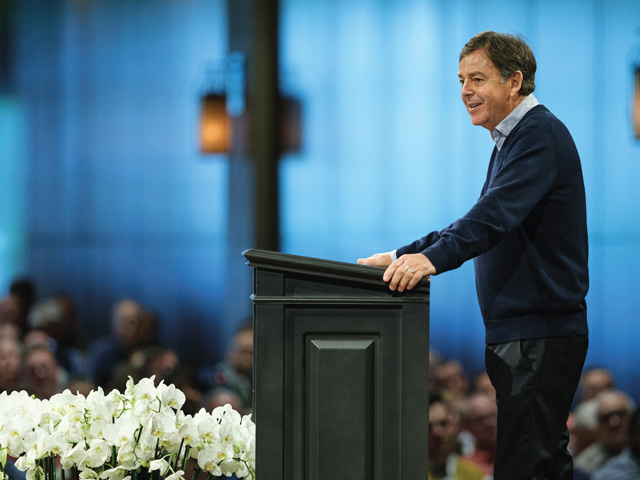
 As we get older, we may not be able to do all that we did as youths, and we may retire from our jobs. But no matter how many years we’ve lived, we still have work to do for God! Find out why when you listen to Truth For Life with Alistair Begg.
-----------------------------------------
• Click here and look for "FROM THE SERMON" to stream or read the full message.
• This program is part of the series A Study in Daniel, Volume 2’
• Learn more about our current resource, request your copy with a donation of any amount.
• FREE AUDIOBOOK! In our polarized culture, disagreement is often seen as combative and offensive. What if there were a way to do it well? Download your free copy of The Art of Disagreeing by Gavin Ortlund and master how to disagree with kindness and influence. Request yours at ‘truthforlife.org/disagree.’
Helpful Resources
- Learn about God's salvation plan
- Read our most recent articles
- Subscribe to our daily devotional
Follow Us
YouTube | Instagram | Facebook | X
This listener-funded program features the clear, relevant Bible teaching of Alistair Begg. Today’s program and nearly 3,000 messages can be streamed and shared for free at tfl.org thanks to the generous giving from monthly donors called Truthpartners. Learn more about this Gospel-sharing team or become one today. Thanks for listening to Truth For Life!
Announcer: As we get older, we may not be able to do everything we did when we were young, and we may retire from our jobs when we reach a certain age. But today on Truth for Life, Alistair Begg reminds us why, no matter how many years we've lived, we still have work to do for God. Let's open our Bibles to the book of Daniel, chapter 10.
Alistair Begg: It is important to realize that the third year of Cyrus the king of Persia is a marker for us to recognize what is going on elsewhere. And here you need to turn to Ezra and to chapter 1 for just a moment in order that you can get a hold of this. Ezra chapter 1 reads in the first year of Cyrus king of Persia that the word of the Lord by the mouth of Jeremiah might be fulfilled. The Lord stirred up the spirit of Cyrus king of Persia, so that he made a proclamation throughout all of his kingdom and also put it in writing. So what have we seen? We have seen that the that God enabled Nebuchadnezzar to take the people of God into exile. Now he has prophesied, Jeremiah 25, that the end of this time would come and there would be the opportunity of repatriation. How was it going to be possible for the people to get back to Jerusalem? Well, God says, I'm going to take care of it. And so he stirs up Cyrus, he puts it in the heart of Cyrus, if you like, and Cyrus publishes it abroad that anybody that would like to go back up to Jerusalem is now free to go, and he says, I will try and enable you as you head out. And so, a number of them leave. But interestingly, Daniel doesn't leave. I wonder if that strikes you the way it strikes me. Wouldn't you have thought that Daniel would be the first person? We would think that he would say, now listen, we're going back and I have been very, very important in this whole program, and I'm going to be at the front at the front of the parade. I want you to make sure that everybody sees me, everybody knows me and that it will be credit will be given where credit is due. Well, there's none of that, is there? There wouldn't be. And he who is humble and contrite in spirit and who trembles at the word. Well, I suppose part of the reason that he wasn't going back is that he didn't want to go back. He wasn't as physically commanding as he would have been as a younger man, and after all, there were people like Ezra and Nehemiah and their helpers who were put in position ostensibly in order that they might do the heavy lifting. So Daniel stays and he does some heavy lifting of his own. What is that heavy lifting? He prays. His faithfulness is revealed in listening to the word of God and seeking the face of God, and as he seeks the face of God, having understood the great conflict that is about to come, he prays for the people of God immediately in their return to Jerusalem and in the awareness of the conflict that will ensue following that return. In other words, quite remarkably he is committed to a project in which he himself had no immediate part, and the conclusion of which he would not live to see. Seems to me that that is one of the great tests, especially as we continue in life. People have told me for 32 years now that Cleveland is on the way back. Apparently, I love Cleveland. It's my home. I mean no disrespect, but it's still got a long way to go. I mean, I can't go to Higbee's and haven't been able to go to Higbee's and Twigbee's and everything for Christmas. Now it's a casino on the way back, apparently. So, without doing a disservice to the town planners and everything else, the missing link it seems to me in a city like this or in other cities is to have leaders who are prepared to lead even though they may not see the fulfillment of their vision. Even though they may not live long enough to realize the radical transformation that is involved, if we only want to operate on that which is immediately gratifying to us, then we will probably never make a dent. The real test is in those who are prepared to see beyond the parameters, beyond the horizon, and to give themselves in faithfulness to that which they will never themselves enjoy. And that's exactly what you have here in Daniel. He is engaged in this even though it is not his to see. That you see is part of the reason that we pray for our unsaved kids and our unconverted grandchildren in the hope that one of the post-humous joys of heaven will be to see then in that day the answer to our prayers. That God has actually fulfilled his covenant promises, and that that for which we have labored long and prayed long and never saw the end to may be ours to enjoy in that day. He was faithful. Secondly, he was also fearful. I'm not going to go all the way through the chapter. You can see how many times that notion comes across. The reports that found their way back to him, presumably did not become the occasion of immediate gladness. In fact, we're told that he was mourning for three weeks. His life was devastated both by the vision and presumably by the reports that came. For your homework, you can read in Ezra chapter 4, and there in Ezra chapter 4, you discover that although the building project had begun, it soon came to a crashing halt. As soon as people realized what was going on and that their focus was still on this God of Abraham, Isaac, and Jacob, they said, we want no part in that. We want to oppose that, and eventually it all stops. And it is in abeyance until you get the beginnings of Nehemiah when Nehemiah is sad in the presence of the king, ensues of the capital, and eventually he goes up and picks up the project that had come to a halt. And so there is a reason as to why it is that Daniel would be as fearful as he proves himself to be. I find it greatly helpful that he is at one and the same time, faithful and fearful. You see, you might think if you're faithful then you won't be fearful, and if you're fearful, you can't be faithful. But in actual fact, I think faithful and fearful is a is an understandable combination. You certainly find it all the way through the Bible. Gideon, you're a mighty man of valor. I think you got the wrong person, Lord. I am the least, I am the smallest. I am Jeremiah, you will be the prophet to the nations. I can't hardly speak, I'm only a youth. What would I do? Moses, you're the man for Pharaoh. Go to Pharaoh and say, let my people go. I'm no good at that, God. My brother, he's really he's a good public speaker, but I I'm not your man. And he who was faithful unto death, who received the crown of life in the Garden of Gethsemane, said, if it might be at all possible, let this cup pass from me. Faithful and fearful. You see Daniel denies the notion of the kind of rugged driving personality. And instead we find him not so much on his knees telling people what to do as on his knees asking God what he should do. So, faithful and fearful, and that's why incidentally the the first word to him from the angelic visitor in verse 12 is fear not. And when he had spoken this word to me, I stood up trembling and he said to me, fear not. You don't have to tell people to fear not if they're not afraid. And thirdly, frail. Frail. It's very straightforward, isn't it? He was faithful, he was fearful, and he was frail. The receiving of this word and the vision laid a great burden on him. The conflict was going to be severe, the conflict was going to involve suffering among the people of God, and his frailty is apparent. He is finding himself in a trance. He's finding himself once again thrown down and on his face. He is struck dumb. His encounter with the majesty and the greatness of God doesn't put him on TV to tell people his amazing story, but actually puts him once again face down. And so what is the word to him? Well, verse 18. And again, one having the appearance of a man touched me and strengthened me, and he said, O man greatly loved, fear not, peace be with you. And here we go, be strong and of good courage. It's similar to the word of God to Joshua, isn't it? And the word of God throughout the Bible. Now, when we think along these lines and we realize that our lives are but a shadow, they're but a breath. We're here today. We're gone tomorrow. We do well just to pause for a moment and see whether this picture in Daniel's life does not have a particular word to say to a certain demographic in this room. I am part of that demographic, and those of you who are not still have to listen to what I'm about to say. I'm speaking now. I'm addressing those who were born a little earlier than others, who have lived into the closing chapters of our lives. Recognizing that God in his purposes has brought us here, and making sure that we realize that in doing so, he has given to us maturity as a gift. We haven't lived this long by chance, and it may well be that our best days are in front of us. Despite the fact that everything in our culture says, there's not much chance of that. You might as well go and fossilize in Florida because you've got nothing to do and nothing to say. Take your retirement package and make a run for the border, and so it goes on. And when we're tempted to do that, especially in in in Christian terms and in Christian circles and in the realm of church work, we are in real danger. Therefore I suggest to you that it is important to take a leaf from Daniel's book. Daniel is not looking back to the good old days. If we had spent time with Daniel, we would have not found him saying, you know, let me tell you about what it was like 70 years ago. It was I I was really on my game then. I mean, we we had it going myself and a few of my friends. Wow, if I could only explain all of that to you, it's terrific. You wouldn't find him doing that. Nor would you have found him involved in regrets or recriminations, and certainly not in nostalgia. No, he knows that he is at this point in time and he has a work to do. His work is not the same as the work of those who are repatriated. His work is not the work of building with Ezra and Nehemiah. His work now is to continue to do what God has enabled him to do, that is to listen to the voice of God and to seek the face of God and to pray for the people of God. What an amazing privilege. What an amazing privilege. And if you find yourself at all discouraged, disheartened, thinking that somehow or another you're beyond the pale, that you've got nothing no real contribution to make anymore, then pay careful attention to this. There is work to be done. The vision has underpinned for him the vital necessity of turning to God in wholehearted devotion, wholehearted dependence, and confessing that we can do nothing and God alone can work. In other words, in 2 Corinthians 4 terms, confessing the fact that we are actually old clay pots. Old clay pots. Now you good if you I was a different kind of preacher, I'd say, turn to the person next to you and say, you are an old clay pot. But I'm not going to do that. But you can do it when you get home. And some of you are thinking it right now. But the fact is we are. We're increasingly cracked. We've been around for a long time. We no longer look the way we once looked. Physically there is a degenerative aspect to it. Emotionally that may be the case. Certainly in terms of cognitive memory loss and all these other things. We recognize that. But God has purposed to bring us to this day, to this particular Sunday in order that we might recognize that we're it's not over until it's over. And if it isn't over, then we must recognize that untold numbers, untold numbers of unknown, faithful, frail, fearful, prayerful servants will be revealed in glory. Untold numbers of unknown people. In other words, when we read in the Bible about the nature of what it will be to see Christ and to be made like him, and to receive the crowns that he has purposed for those who are his own, none of us will be disappointed with what we receive. But we will be surprised, I think, without being disappointed and we'll say, how in the world did that elderly Mrs. so-and-so end up in such a beautiful place? She never seemed to do anything in the church at all. Well, what do you know? What do you know? The God who sees in secret will reward her openly. Oh, she didn't have a profile, he didn't have a profile. He was never up front. He never did anything at all, apparently. Oh, you don't realize that the faithful, fearful, unknown ones may be the very first while having been last. And those of us who were apparently first have been moved a little further down the food chain and understandably so. None of us will be disappointed. It will all be perfect on that day. Well, you say, you're a little steamed up about this, aren't you? Well, I am a little, yes, I must say. Must be feeling my age. In actual fact, my trip to Ireland generated some of this in me. As I was studying the Bible, I find myself going in this direction, and it's partly because my visit to the north of Ireland last week was was the occasion of a number of sort of painful discoveries. At one point, as I was sitting in the congregation, someone referred to the to the older people in the group, older people being anybody over the age of 60. I said, okay, well, that's me. And then and then also I found out that I I qualified for a for to travel on the buses for free. Which is I guess supposed to is a compensation for the fact that you're you're on your way out, you know. And then I thought, well, that'll be good as a Scotsman. It appeals to me. Anything for free is absolutely terrific. But in actual fact, it really came across to me when I was saying goodbye to a couple that I had known when I was there previously, when I was 45 years of age. That was my last visit to this particular church. And I said to the couple, I said, well, go on your way, go home and and and I will go home, and if if we continue on the 18-year cycle, then I I'll be back when I'm 81. And then I thought 81? But the thing that really drove it home for me was a visit that I made to one of my heroes. The hero is a lady, her name is Helen Roseveare, a medical doctor and a missionary in the Congo from 1953 on. She went to Congo when I was one. I had read her book as a youngster. Soon I had had her in our home in Scotland. She visited here. She graduated from Cambridge, and she went as a single woman to the Democratic Republic of Congo or whatever it is now. It was while she was there that some of her colleagues were killed by terrorists, and she was imprisoned for five or six months during that time. And after 20 years, she finally came home. Her biography will repay your reading, it's called Give Me This Mountain. That is an autobiography and in it she recognizes the fact that she was not an obvious candidate for missionary service. Indeed, she says that she almost failed to be enlisted in the ranks of missionary endeavor with the Worldwide Evangelization Crusade. And the reason she said that she was going to fail was because of her failings. And that was that she was a bit of a know-it-all. She was phenomenally stubborn, and she had an ingrained inability to work with others. And yet God took her up and crushed her a little. And the story of her life is actually the story of treading deep, deep, dark valleys and getting a glimpse of mountains. And the autobiography is of course, the title of it is taken from Caleb, give me this mountain. Here I am today, 85 years old, and still as strong as I was at the first. It's an amazing thing. And I found out that she was living she had been taken into a nursing home just a few miles away from where I was taking and staying. And so I asked to borrow a car and I and I went to see her. And she she's had a stroke. She's 90 years old. She was paralyzed all down her left side. And as we sat together, she never said a word. If you know Helen, she has amazing eyes, beautiful eyes, but scary eyes. You know, you could never if you were burbling on, you could tell without her saying anything that she knew you were just burbling on. Anyway, her hair was nice, her glasses were clean, they had cared for her. And she laid in her bed. And I had to do all the talking, which was really hard for me. And eventually we read we read from the Bible. She listened as I read, and then we held hands as we prayed. And as I prayed, she she squeezed my hands. And so the time was gone. And I said, I'm going I have to leave now. And if Sue knew that I was here, she would send you her love. And the lady who was in the room, who had been caring for her, a lady by the name of Pat, said to her, Helen, Helen, do you have do you have a greeting for Alistair to take back to Sue? Nothing happened. And she said, Oh, come on now, Helen. Do you have a do you have a blessing for Alistair and Sue? She moved her head just ever so slightly in her pillow, and she turned towards me. And at this level of volume, she said four words. Keep on keeping on. Keep on keeping on. Seems to be the lesson here, isn't it? 86, 88 years old. Not nostalgia, not regret, not a fascination with himself, but an ongoing commitment to the vision that God has given him and the fulfillment of God's purposes. You see, in in in the life of an individual and in the life of a church, it will be this overarching reality which will galvanize, sustain, develop, and quicken us for the coming generations. You see, when we talk about building into the next generation, this is not this is not hot air. Some of us have got to be a little more diligent than we've been, and step up to the privilege that we enjoy. And even though we're frail and even though we're fearful, with God's help, we can be faithful. And as the chapter ends, of course, Daniel is consumed with the fact that eventually this one who is to come will reign forever and forever.
Announcer: You're listening to Truth for Life with Alistair Begg. Alistair will return in just a minute. Here at Truth for Life, we strive to offer biblically solid books. We can recommend to you books that will provide insight into a broad range of God's truth. And this month, we're recommending a book called The Story of God and Us. It covers the entirety of scripture. It's a sequential retelling of the story of the entire Bible, God's overarching plan for our salvation. As you read this book, you'll see the author pointing out important lessons and warnings along the way, specifically, what are we supposed to learn from those who faithfully trusted God, even through trials, and those who didn't? You'll be prompted to think deeply about your own faithfulness to God, his faithfulness to you, and how you fit into his eternal story. The Story of God and Us is a compelling book. You'll find it hard to put down. And if you've never read all the way through the Bible, this is a book that will help you connect some of the missing dots. Ask for your copy when you donate to support Truth for Life's ministry. You can give online at truthforlife.org/donate or call us at 888-588-7884. And before we're done here today, let me remind you, if you are in pastoral ministry, the Basics Conference is just around the corner. It takes place the end of September in Valencia, California. It's a great time of Bible study, worship, fellowship that will encourage both pastors and seminary students to do the basics of ministry well. And if you've not secured your seat yet, be sure to register today at basicsconference.org. And if you're a student, there are student discounts available. Now here's Alistair with a closing prayer.
Alistair Begg: Well, Father, thank you that your word is worthy of our study, is worthy of our submission, is worthy of our trust. Thank you that eventually as we think of Daniel, in all of his willingness to serve you the living God, we eventually find our gaze caught up in the Lord Jesus Christ himself. And he is the one who urges us to be faithful unto death in order that we might receive the crown of life. Help us to know this morning that in our world with all of its twists and turns, in all of its chaos, and in all of its discord, that Jesus Christ is Lord of all, for we pray in his name. Amen.
Announcer: Thanks for listening today. If you were to receive a prophetic message from God, that sounds kind of like a mountaintop experience. Daniel's experience suggests otherwise. And tomorrow, we'll examine his vision and his response. The Bible teaching of Alistair Begg is furnished by Truth for Life where the learning is for living.
Related Episodes
The Spiritual Forces of Evil (Part 1 of 4)
Tuesday, August 4
Gabriel and the Seventy Weeks (Part 2 of 2)
Monday, August 3
“Do You Believe…?” (Part 2 of 3)
Saturday, August 1
About Truth For Life
Truth For Life distributes the unique, expositional Bible teaching of Alistair Begg. Studying God’s Word each day, verse by verse, is the hallmark of this ministry. In a desire to share the good news of the Gospel without cost as a barrier, the entire teaching archive is available for free download and resources are available at cost with no markup.
About Alistair Begg
Alistair Begg has been in pastoral ministry since 1975. Following graduation from The London School of Theology, he served eight years in Scotland at both Charlotte Chapel in Edinburgh and Hamilton Baptist Church. In 1983, he became the senior pastor at Parkside Church near Cleveland, Ohio. He has written several books and is heard daily and weekly on the radio program, Truth For Life. The teaching on Truth For Life stems from the week by week Bible teaching at Parkside Church. He and his wife, Susan, were married in 1975 and they have three grown children.Contact Truth For Life with Alistair Begg
Website
http://www.truthforlife.org/?utm_source=oneplace&utm_medium=sitelinks&utm_campaign=home
Mailing Address
Truth For Life
P.O. Box 398000
Cleveland OH 44139
Telephone (Customer Service)
888-588-7884 Domestic
400-543-6800 International
440-543-0522 ( Fax)


